https://lcb.wa.gov/examiners/recalls
The most recent product recall announced (quietly) on Monday by the Washington State Liquor and Cannabis Board appears to be the most extensive one in the 10+ years that they have been pretending to do product recalls.
The link above gives specifics on the alleged recall — in the typical non-transparent and virtually useless way that the WSLCB has spent years and hundreds of millions of taxpayer dollars refining.
Look at the link and ask yourself, as a concerned potential consumer, just how much of a shit our regulators give about consumer safety in the multi-billion-dollar regulated cannabis market from which they routinely pull hundreds of millions of tax dollars (and license fees and fines).
In a nutshell, 529 “batches” of DOH-compliant (“Medical-Grade”) product from Northwest Cannabis Solutions were found to have (and I quote):
“High level of concern for pesticides/residual solvents.”
The recall announcement includes an Excel workbook listing the 529 batches, including “batch number” and a brief description of the recalled products. On a separate sheet, 129 retail license numbers involved in the recall are listed — presumably so that the 20 or so people in the state that know how to use those numbers can evaluate whether or not they shopped at a store that carried the tainted product SKUs. That list was not even labelled as retail cannabis license numbers. Go figure.
Being one of the people that knows how to use those numbers, I appreciate the transparency of the WSLCB’s efforts. Supplying a list of 129 6-digit license numbers is about as useful as the decision they made last week to completely cut off all oral public comment during their increasingly infrequent public meetings. Transparency — the Chair Jim Vollendroff way (GO LCB!). It’s almost as if he is channeling the dysfunctional way in which ex-Chief Nordhorn has attended to his duties these past 10 years. The Senate Labor and Commerce committee is meeting on Friday and is expected to confirm Mr. Jim’s appointment as Chair of the WSLCB Board during their Executive Session. If you feel like it, today might be a good day to let your Senator know that you don’t think he should be confirmed. This happened under his watch, after all.
Anyhow, as consumer safety in the regulated cannabis space has largely been my thing for the past few years, I thought I’d try to add some value to concerned citizens (and immigrants) concerning the WSLCB announcement of the recall of all that NWCS supposedly DOH-grade product.
WHAT WAS IT, ALLEGEDLY?:
It looks as if the 529 tainted “batches” involved primarily Cartridges and Disposable Vapes (thanks for all the toxic waste those add to our landfills and salmon habitat, NWCS) and some bud-tender samples that were supposedly made from the following strains of cannabis:
-Wedding Crasher
-White Widow
-Super Boof (NOT to be confused with lesser Boofs)
Personally, I did not know that disposable vapes were intended to be used rectally. One might think that the moisture up there might be a bad mix for any lithium that might be in the batteries — but what do I know? Perhaps they are sealed well enough in their micro-plastic-bearing cases to keep the rectal moisture away from the lithium. Concerned consumers (who would not be using disposable vapes, anyway) can only hope.
WHAT WAS ALLEGEDLY WRONG WITH ALL THOSE SKUs?:
Something to do with having too much of the wrong (or right) pesticides and/or too much residual solvents. Of course, we don’t know (at this time) thanks to the quirks of WSLCB recall reporting WHICH pesticide(s) are/were involved, how MUCH of that/those pesticide(s) were present, WHICH residual solvent(s) were present at higher-than-allowed levels and how MUCH of it/them were present.
Your guess is as good as mine. Could have been myclobutanil (which produces cyanide when heated). Could have been benzene, which is generally regarded as carcinogenic. Then again it/they may not have been. We just don’t know. Perhaps the WSLCB does not know either. Seriously — that is possible.
WHICH STORES HAD IT ON THEIR SHELVES?:
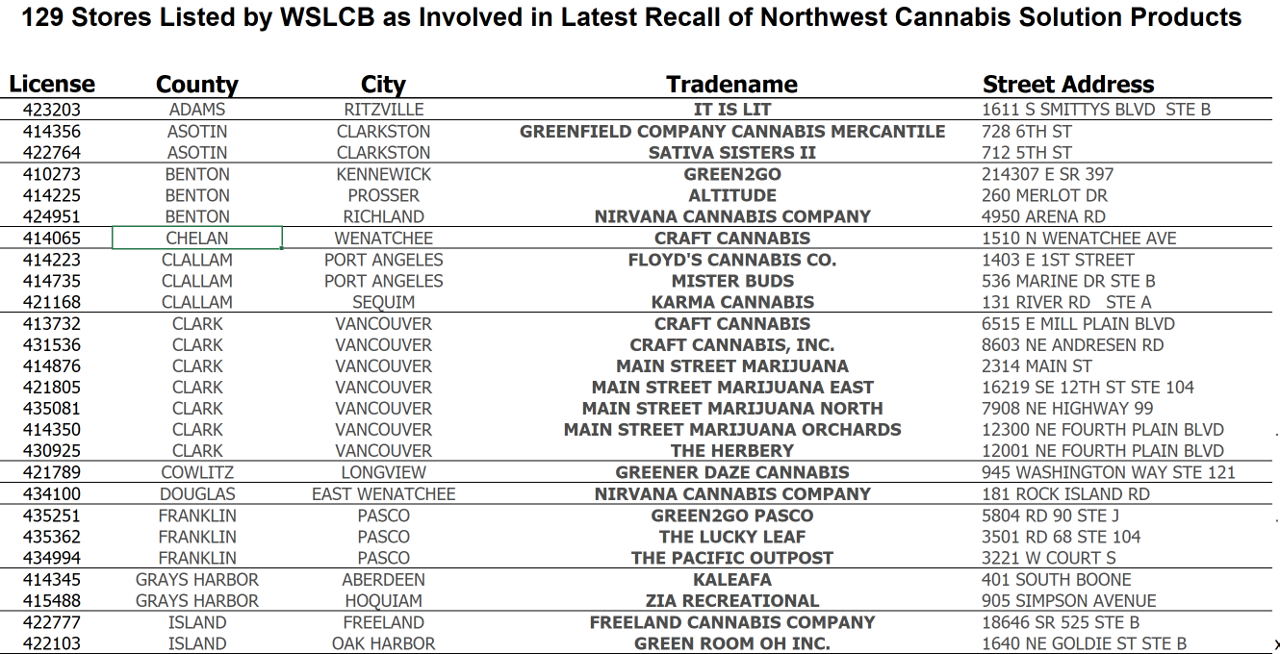
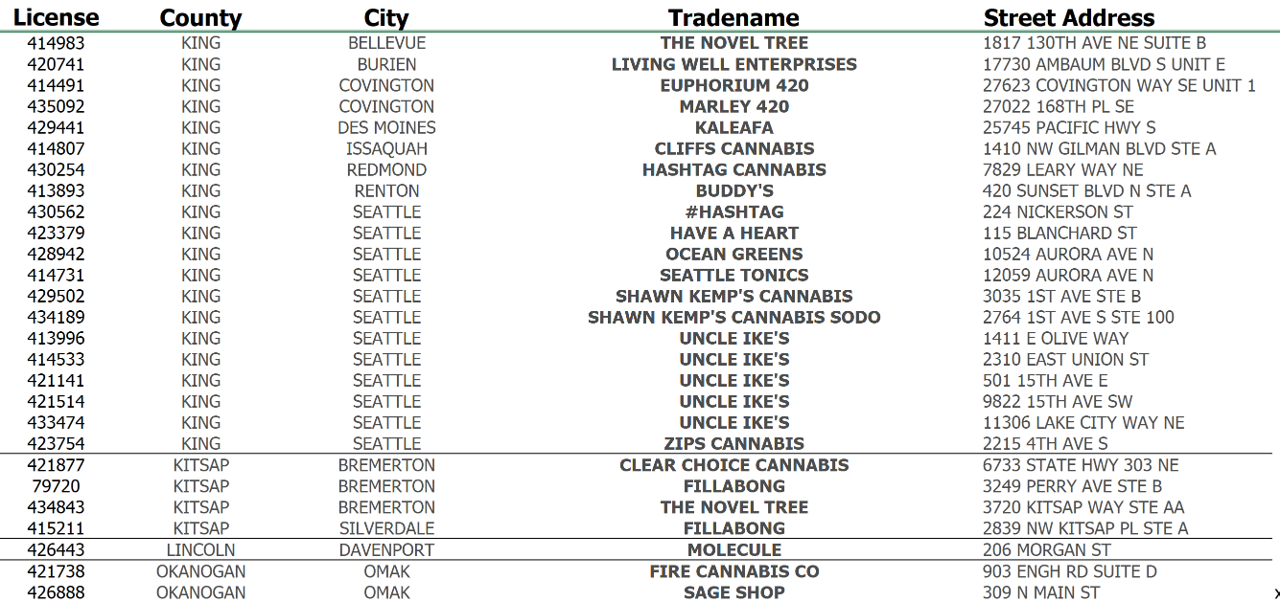
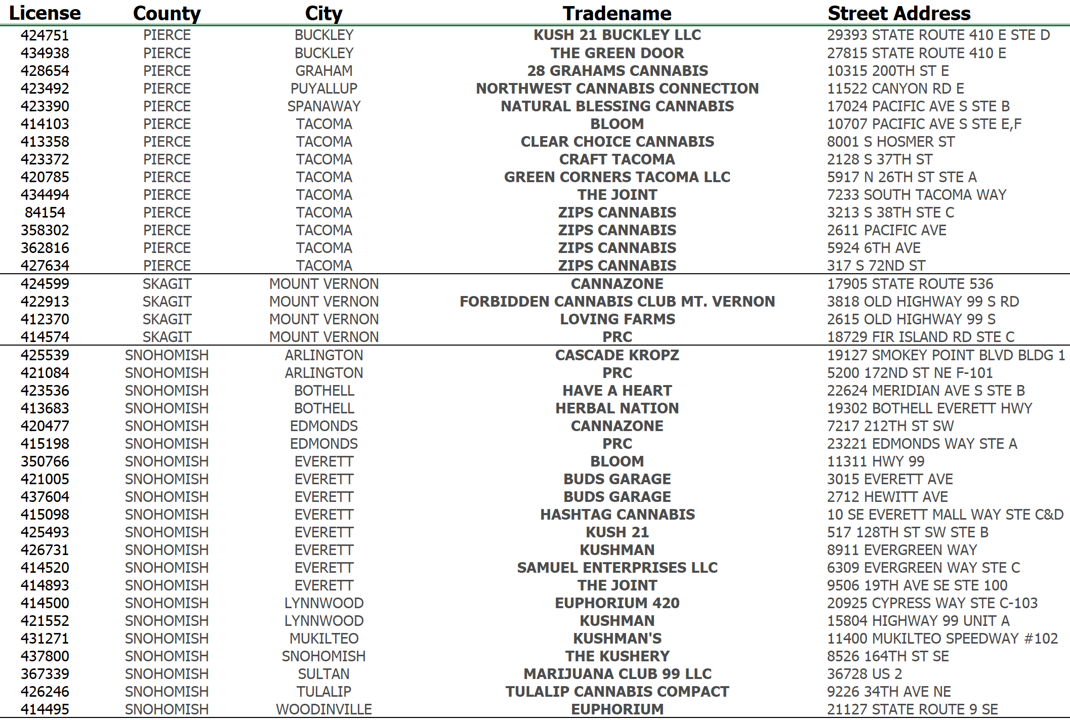
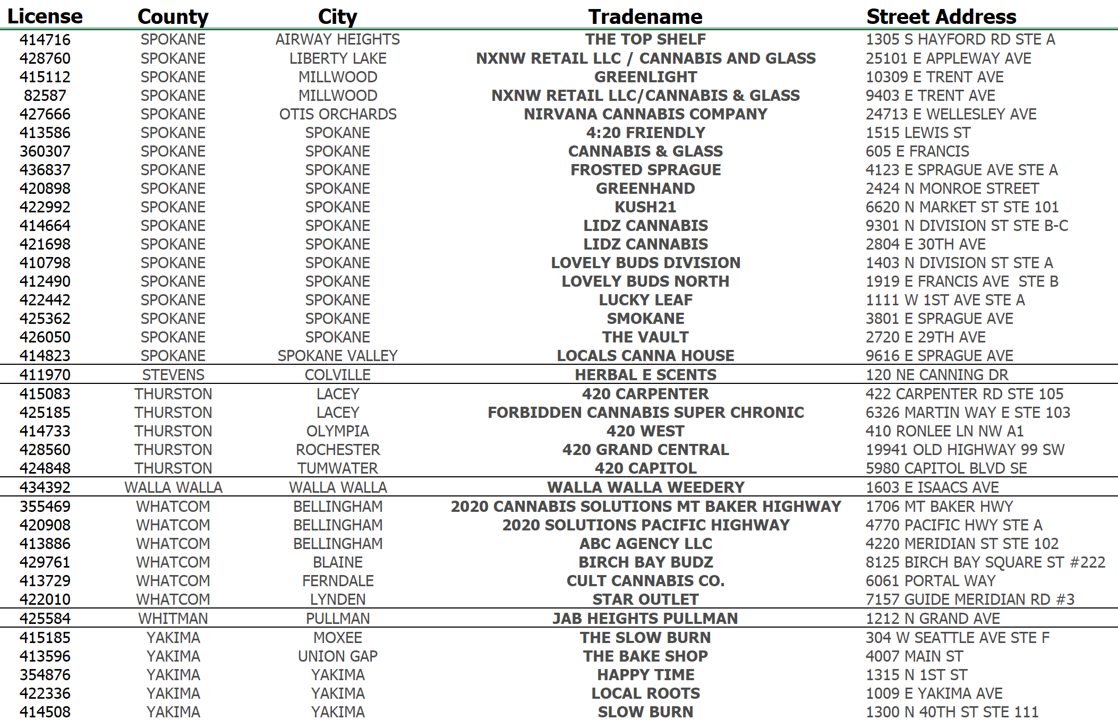
Looks like 129 license numbers. Now isn’t that useful? I’ve taken the liberty of decoding those and listing the 129 stores below that correspond to the numbers the WSLCB was so kind to share with the CORCs of Washington (Consumers of Regulated Cannabis).
WHAT DOES IT MEAN?:
In my humble opinion, the 2 million + CORCs in this state are naive in assuming that the regulated market provides “safer” product than does the unregulated market. At a minimum, the safety that competent regulation and regulatory oversight are supposed to ensure is lacking. Unfortunate in many ways, but particularly in that such safety is part of the promise that supposedly justifies the state taking some 43.5% of every purchase made by trusting (and foolish) CORCs.
Icing on the cake — the product was all supposedly tested to DOH-grade. Even the tainted budtender samples that they gave to their unsuspecting customers. Patient-ready stuff yessirreee!. Good clean meds — the Washington state way.
Cherry on top of the icing on the cake — the Washington State Legislature does not appear to be moving the Home-Grow bill forward this session. If you want cannabis in this state, you either buy the regulated stuff (with it’s pesticides, residual solvents, heavy metals, yeast and mold and whatever) or you source it illegally. Either pay the nation’s highest cannabis taxes or be a criminal.
Or don’t use — it’s your choice. It’s nice the little monopoly they’ve created for themselves.
Wouldn’t it be wonderful if you could grow your own and ensure that no nasty crap got into your plants? Just about every other regulated state allows that — and WA was the FIRST to legalize cannabis for general adult use over a decade ago.
If you care, let your state legislators and senator know THIS WEEK that you’d like them to pull the apparently defunct homegrow bill from the trashbin and bring it to the floor for a vote. The bill goes by the name “HB-1449”.
Enough ranting. This crap has energized me and I expect to be looking at some of the newer data that permeate this market. I’m going to give the Legislature one more chance to do the right thing and give Washingtonians the ability to legally grow a few plants for themselves if they wish. If not, then I’ll do my best to give CORCs (and potential CORCs) information that might just contribute to further reductions in their goddamn cannabis tax revenue stream.
Here’s the stores that apparently purchased the tainted product involved in this specific recall. They are listed alphabetically by store name, within city, within county. Remember that the recall relates to the 529 batches of Northwest Cannabis Solution products I identified above.
THIS list is about the subset of stores (and the store chains) that, for some reason, seem to like selling Northwest Cannabis Solutions products.
Cheers — and a happy vernal equinox to you all.
Thank you Jim. I hope you are doing well.
Safety issues haven’t changed much it appears.
I would still love to be able to track where each dollar of tax revenue goes (specifically) when it leaves the “General Fund”. Do they still even call it that?
You are welcome, Jason. How nice to hear from you!
For anyone that does not remember the good old days, Jason owned and ran one of the good, honest, PRAGUE labs in the state. He and his team were active in identifying bad behavior in some of his peers and attempting to get the WSLCB to effectively enforce the sector.
For his troubles, his lab and staff enjoyed things like “SWAT Teams” raiding his facility and threatening his staff. Ultimately, the WSLCB forced the lab to close and, to the best of my knowledge, never acted upon any of the very real evidence-based problems that he brought to their attention.
Jason — you’ll no doubt enjoy the irony that there are labs out there today happily doing tests FOR WHICH THEY ARE NOT CERTIFIED (remember Green Grower and antimicrobials?).
The WSDA is now playing the primary role in certifying the labs and they appear to have raised the bar on what is necessary to test cannabis in this state’s regulated market. With that said, there are some very ugly things in the lab space here that I’ve decided to dive into a bit more. I’ll post the results here when I get through the morass of data, but it’s an interesting picture that is emerging.
I hope you are thriving in your new endeavors. You were one of the good ones, and you earned the respect and admiration I feel for you.
On the revenue distribution question, there is a new “dashboard” on the LCB site at the following link that shows a bit of high-level information.
It’s only been up for about a month, but it’s interesting.
https://lcb.wa.gov/research/cannabis-account
Happy Equinox!
Thank you so much for this informative post, Jim. It may affect some of our patients, as many of the medically endorsed stores in Tacoma are represented in this list. Upon reviewing the rcw pages linked from the recall post, I am still not certain of how one would return the recalled product. Are you aware of the appropriate steps, or should I advise anyone in possession of recalled product to simply bring it back to the store where they purchased it, regardless of if they still have the receipt?
The LCB recall rule has, as you discovered, more of a CYA emphasis (See … we are putting responsibility on the licensees to document what they each will do in the face of a recall. Aren’t we doing a great job?) than a consumer-protection emphasis.
I believe you are correct that the best thing is for the patients to return the products to the store they purchased the product from. It would be helpful for them to take a photograph of the product package, if they still have it (the label used to contain information about the lot and the store from which it was purchased …. but I am not sure if that is still required to be on the label). Regardless, the photos may help down the road.
Each store pretty much has to take back returned product, if it is subject to a recall. It would be nice of them (I’m not sure that the LCB REQUIRES it) to give full refunds for the purchased product, or replace it with a similar non-recalled product. Any store worth it’s salt with respect to customer service and decency would refund patients (and any consumer) to whom they sold tainted product.
Remember — The store did not know it was tainted when they sold it, and I’d imagine quite a few store people are a bit upset with NWCS at the moment.
IMO, any replacement products that the stores offer (IF they do that) would best be from a different vendor (but that’s just my opinion).
Bottom line, the LCB Rules allow stores to pretty much do whatever they want in this situation, but the good ones will take the product back, give full refunds and/or replacement products and THEY will deal with disposing of the product (likely by returning it to NWCS, if they still do business with the vendor).
Hope that helps.
ps — if any of your affected patients are given a rough time by the store(s), I’d appreciate if you would let me know the specifics.
Great post.
Why did WSLCB discover everything so late? 529 batches are a lot of items, why not WSLCB take action when the first batch tested failed?
I honestly do not know, but it is typically the case that the WSLCB announces recalls — as you perceptively state — “late”.
I DO know that neither the WSLCB nor the WSDA Hops Lab have, traditionally, prioritized rapid turnaround of pesticide test results on samples seized by LCB officers.
Indeed, given some of the delays I’ve seen in looking at the WSDA test data), it’s a fair bet that contaminated product has completely sold off to the public prior to the WSLCB announcing a recall.
I’m just not sure.
In any case, it is not even a guarantee that THIS recall stems from contamination discovered by the WSDA lab. The way the WSLCB reported this recall is significantly different than anything I’ve seen in the past 9 years. Even the way they worded the REASON for the recall is weird when compared to prior REASONS (when they are given).
What they said was: “High Level of concern for pesticides/residual solvents.”
No specific pesticide listed. No specific level of contamination listed … nada …. just a CONCERN.
It’s odd — I don’t know what more to say.
Hey Jim, first time caller, long time listener here. I want to lead by saying I really, truly appreciate all the work you’ve done to shine a light on the numerous unethical and downright unsafe practices in the industry. I’ve worked in management on the farm side of the Washington cannabis industry for about a decade now, and am pretty jaded by the state of things. As someone that has been a believer in medical applications for cannabis for a long time, it is very disappointing (though not surprising) to see where things have ended up. I’ve long feared that someone with a compromised immune system would consume a product sold to them as medical grade, and end up sick or worse as a result. It seems we’re closer than ever to that reality if it hasn’t happened already.
I wanted to share my personal experience with working with the WSLCB to implement a product recall for one of the farms I’ve worked at, as it may confirm some of your suspicions re: the NW Cannabis recall. The farm I was working for at the time had some LCB randomly selected samples fail for non-approved pesticides, which as you probably know are VERY commonly used despite their place on the non-approved list. It took almost a full year for the LCB to get their lab results back and contact us about it. Perfect for a product that has about a 3 month shelf life when it isn’t a concentrate. By that time 100% of the product had long since left our facility for store shelves.
The LCB shifted all of the work regarding notifying stores that had received tainted products onto me, and as best as I can tell did zero follow-up work with these locations to see if there was tainted product on the shelves still, and to ensure it was properly recalled if so. In the words of the LCB officer I was coordinating with for this recall, “It isn’t my job to manage their inventory for them.” He seemed satisfied that we had gone through the proper motions that his boss wanted him to and the case was closed, with only a written warning on our side to show for it. Maybe given the scale of this NW recall they will be more diligent in their work, but I know I wouldn’t bet on it.
I say all this to point out that you’re probably right about all of the source material/affected lots for these failures is probably in the wind at this point. Given the amount of concentrates that NW deals in, it is possible that some of this may be lingering on shelves still, but as you acknowledged in another comment there will be a web of middlemen processors to untangle to figure out who got what from who and when. I would LOVE for the wheat to be separated from the chaff in this industry, but the more time I spend in it the worse things seem to get. I think we’re at a point now that anyone still growing black market product has a cleaner, safer product than the average jar or cart sitting on a store shelf. Caveat emptor indeed.
Thank you again for all you do, I’ll be waiting for any follow-up you have on this recall.
I very much appreciate your comment and sharing your real-world experiences in it. My regrets on taking so long to respond. I don’t go into WordPress frequently (infrequently enough that I actually had difficulty getting to my “administrative” access this past week). I will try to be more discplined at checking periodically.
Your observations confirm a number of suspicions I have been developing through both looking at the data (e.g., time lapsed between product seizure, lab test and recall reporting) and talking to people that have been involved in recalls and/or pesticide violations that do not appear to be associated with a product recall.
Interesting and confusing stuff, IMO. It almost seems as if the Enforcement and Education personnel don’t care about product (or consumer) safety. Perhaps it’s a cultural problem.
Thanks again — I found your comment informative.
i gotta wonder where else that extract went? as in did they sell to other processors? cause if so that’s a huge house of cards coming tumbling down. out of the biz now and living in a far away land TFG! always questioned how they could breeze their garbage through testing cause wink wink i think we all know this has been happening for many years.
I miss American Baked Company’s presence in our state. I hope you are well in your new home.
I intend to look into this recall closely, but compiling all of the data is going to take more time and attention than I can give it for the next couple of weeks.
I’ll post what I find, if it’s interesting. I suspect it will be, as the way the WSLCB posted this recall is truly unique. Something is up, I suspect.
It’s best to remember that it is also possible that they purchased the extract from someone else and then bundled it up into the recalled products. I just don’t know yet.
NWCS has been on my radar since at least back when I first noticed the phenomenon of “lab shopping” in WA’s market. The table that I included in the post on that (the one that showed an unnamed wholesaler periodically sending product out to multiple labs, and then going for a few months with only 1 lab (often the one that gave the highest THC in the multi-lab month), and then following up with another multi-lab month, and then changing labs to the new “winning lab”, etc.
NWCS was the wholesaler whose data were on display in that table. I initially chose them because they did so much testing and the pattern of their lab choice behavior over time inspired my use of the term “lab-shopping”.
I’ve said it before, and I’ll say it again here— I would never knowingly consume, purchase, or advocate on behalf of a product with one of their many brand names attached to it.
Some of the behaviors are questionable at best. It is like my ex-business partner telling me that I should have just “signed off” on samples so that we could be competitive as a lab and give results that would keep people coming back. I refused to “sign off” on items because it represented a conflict of interest as a lab owner in addition to ethical concerns. All digs intended here.
I only see see one solution to skirt the “lab shopping”. (Not to say there aren’t more or better solutions) The samples should be submitted to the State and the State should blind them and randomly send the samples to to random labs. Sure it will cost the State more, but aren’t they supposed to ensure end user safety?
In today’s day and age just remember the adage -“the solution to pollution is dilution”. Sounds like it could be the pervasive mantra.
Thank you Jim. I wrote this rapidly, as I am out of that arena, for now, but wanted to weigh in with a nickel’s worth of free words. I hope this post makes sense.
As always, Jason — I appreciate your perspective and the time you take to respond on what I know we both believe to be important issues.
My regrets on taking almost 7 months to respond. I don’t go into WordPress often anymore. I’ll try to be more attentive to comments in the future.
Great info Jim please keep this site up and going. I’m registering and starting to share it out to people that are going to engage in all of this amazing content ✅ it’s time to end the monopoly on our health
Thank-you, Levi. I’ll keep it up and running for awhile (likely at least the next couple of years), but my posting will be limited.
Many of the design decisions that the Agency forced into CCRS (often over the rather vocal objections of many of the 3rd party integrators) have led to data completeness and quality issues that seriously degrade the utility of the “seed to sale” system to support the type of analytically-driven posts that I tend to prefer. It increasingly strikes me as amusing that the self-imposed damage to this key data resource has also degraded the ability of the WSLCB to effectively regulate this state’s legal cannabis market. Perhaps the Feds will take notice — perhaps not.
Facts over Bullshit is an important mantra to me, whereas the increasingly opaque Agency that regulates all “legal” intoxicants in this state (to be honest the DOH regulates some, as well) seems to prefer BS over descriptions of reality based on fact. At least the State Auditor’s office seems to be on to them, as — increasingly — do those portions of the Legislature that are paying attention.
When I eventually bring the site down, I’ll give lots of warning and will likely figure out some way to archive the information that is in there.
Again, I appreciate your kind words.